
Can Verona’s Flying Donkeys Find Their Way Back from the Football Wilderness?
By Dan Cancian
William Shakespeare set his plays in Verona, but even he may have struggled to match the pathos of one club’s ascent and eventual downfall.
Long before Atalanta lifted the Europa League and Como rose from Serie D to qualify for the Champions League, Chievo Verona upended Italian football’s status quo.
One of calcio’s biggest fairytales, it may in fact not even have been the city’s greatest sporting miracle. That would be Hellas Verona winning the Scudetto in 1985, in the process becoming Veneto’s first and hitherto only club to be crowned champions of Italy.
Chievo, meanwhile, had just finished seventh in the Girone C of the Campionato Interregionale – the present day Serie D, the fourth division of Italian football.
Hellas fans may have lived a fairytale, but they wanted none of the same for their neighbours.
“Quando i mussi i volerà, faremo il derby in Serie A,” read a banner at the Stadio Bentegodi when the two Veronese clubs met in Serie B for the first time in the mid-1990s.
It roughly translated to ‘donkeys will fly, before we play each other in a derby in Serie A’. Dismissive as the banner may have been, it was also difficult to disagree.
Chievo, after all, were the team from the eponymous small suburb in Verona. Plonked on the right bank of the Adige River, approximately three miles north of Verona’s old town, it only became part of the city in 1927.
As Tim Parks, author of A Season with Verona, observed in The Guardian: “I’d lived in Verona more than 10 years before I stumbled across it, a miserable case of working-class suburb overflowing into declining semi-industrialised fenland.”
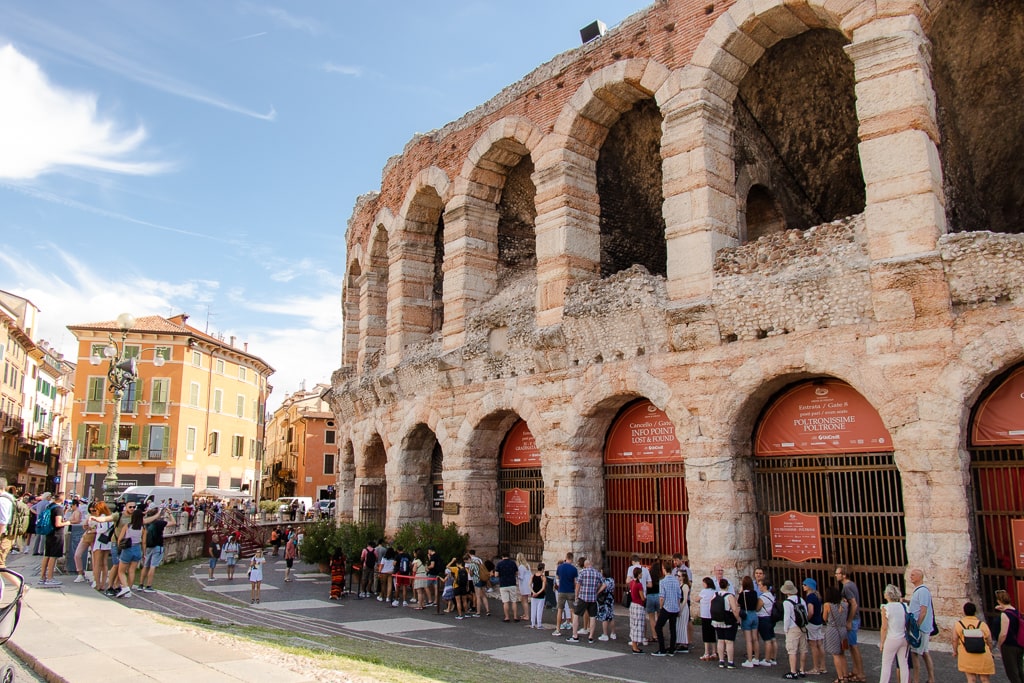
Despite its geographical proximity, Chievo remains a world away from the image one has of Verona, with its cobbled streets, the stunning Piazza delle Erbe and the iconic Arena – the Roman amphitheatre.
Yet the passion for football burns bright in both parts of the city. When Destination Calcio visited we had a drink with Verona ultras in one of their favourite pubs – where you would do well to remember to keep your phone in your pocket – right by by the Stadio Marcantonio Bentegodi, which served as Chievo’s home between 1986 and 2021.
The Clivensi now play just across the road at the Stadio Aldo Olivieri, whose 2900 capacity is a world away from the cavernous Bentegodi. It is an apt metaphor for their relationship with Hellas, to whom they have always played second fiddle.
Chievo the suburb was only notable for its dam and Italy’s cake-making giant Paluani. So low was the club’s profile, they were renamed to Paluani Chievo between 1981 and 1986, when they returned to their original AC Chievo denomination following promotion to Serie C.
The name changed again a few years later. “Chievo Verona they call themselves these days. Otherwise people might not know where the hell the place was,” Parks drily noted.
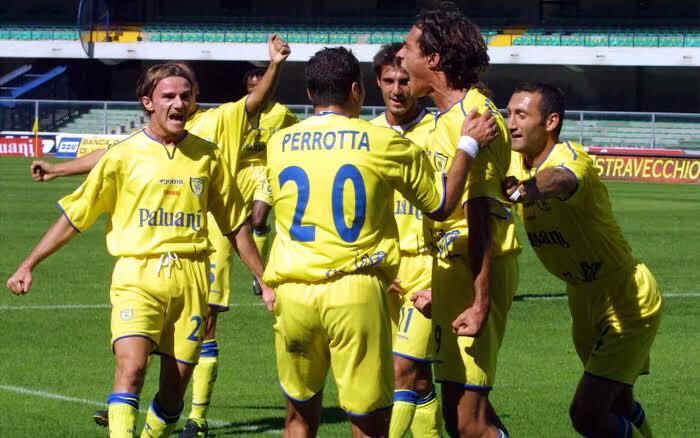
By the time his column was published, Chievo were on the football map after winning promotion to Serie A in Luigi Del Neri’s first season in charge.
The donkeys were not only flying, but they had landed in calcio’s upper echelon. As players and fans celebrated in the streets of Verona, they turned the Hellas slight against them, parading winged cardboard donkeys through the city.
Chievo even adopted the Mussi Volanti moniker – mussi is Venetian dialect for donkeys – with players and fans alike relishing the chance of turning the tables on their neighbours.
It was barely the beginning. Within three months, Chievo were top of Serie A and the toast of Italian football, much to the chagrin of the Hellas fans and, to an extent, of Del Neri.
A man with more than a passing resemblance to the Inspector Clouseau character played by Peter Sellers in The Pink Panther series, Del Neri had little time for fantasy.
“Would people stop talking all this saccharine stuff about fairytales,” he said as Chievo moved top of the league in October 2001. “There is no fable here. Chievo is the result of hard work, on a daily basis.”
In a sense, he was right. With their thrilling brand of attacking football, there was nothing casual about Chievo’s blistering start to the season. Eriberto and Christian Manfredini were electric on the wings, while journeyman Eugenio Corini kept the team ticking in midfield. Up front, Massimo Marazzina and Bernardo Corradi formed an effective striking partnership.
Club president Luca Campedelli, was more inclined to buy into the feelgood factor.
“Of course we’re not thinking of finishing top,” he said. “We’re happy now. Just let us be happy.”
Chievo had been part of the Campedelli family since 1963 when Luca’s father and Paluani owner Luigi had become president. Following his sudden death in 1992, Luca stepped into the void left by his dad, with former Chievo defender Giovanni Sartori as sporting director.
The latter has since gone on to become one of Italy’s best sporting directors, first alongside Gian Piero Gasperini at Atalanta and now at Bologna.
Campedelli’s first task was to convince Alberto Malesani his job was safe. Malesani had left his post at Japanese camera giants Canon and served as Chievo’s academy coach, then assistant manager to the first team, before being promoted in 1993.
So low was his confidence in the team that he reportedly asked Campedelli for a job at Paluani as an insurance policy, in the event things went south. He shouldn’t have worried, as he won promotion to Serie B at the first time of asking vindicating the president’s faith.
Remarkably, only two years earlier, Campedelli’s father had acquired a minority share in Verona and briefly floated the idea of merging the clubs as he wanted Chievo “to be more easily associated with the whole city”.
By 2001, Malesani had moved across the divide as Verona and then-league leaders Chievo met at the Stadio Bentegodi in Serie A for the first time.
It was never going to be a normal occasion and so it proved, with Verona coming back from two goals down to win 3-2. Chievo, however, had the last laugh, as while they ultimately finished the season in fifth place, falling just short of Champions League qualification, Verona were relegated.
Chievo did reach the Champions League five years later, when the fallout from the Calciopoli scandal meant their seventh-place finish was upgraded to fourth, earning them a ticket to the play-off stages of European football’s showpiece event.
But it was too good to last. Chievo were relegated to Serie B after finishing bottom of the table in 2019, before going bust two years later when the impact of the Covid-19 pandemic and financial difficulties took their toll.
So long the face of Chievo’s fairytale, Campedelli was now anything but. When former Chievo player Sergio Pellissier founded his own club in 2021 to carry on the Flying Donkeys’ sporting tradition, Campedelli prevented him from using the name Chievo, despite the fact the club had effectively ceased to exist.
Pellissier, who scored 134 goals in 496 league appearances over 19 seasons with Chievo, started his own club anyway, calling it Clivense, a nod to Chievo’s nickname – Clivus meaning Chievo in Latin.
Three years later, as Clivense won promotion to Serie D, he purchased the Chievo name, brand and sporting history.
Pellissier remains the honorary president but Chievo have welcomed in new investors, chief among them Pietro Laterza, the owner of Dubai-based Al-Ittifaq, who currently count a certain Mario Balotelli in their ranks.
Laterza has completely renovated the club’s historic Bottagisio training centre and brought back former Chievo star Andrea Paloschi, who spent five seasons at the club between 2011 and 2016, and then signed Douglas Costa, who won six league titles with Bayern Munich and Juventus.
Paloschi rattled in 11 goals in Serie D last term at the tender age of 36, while Costa made 11 appearances.
This season, Chievo began the campaign with a 1-0 win over Calcio Pavonese. Promotion to Serie C is the stated ambition as Laterza wants them back in professional football to celebrate their centenary in 2028.
Can the Flying Donkeys take off again? There has never been a better time to find out, and with Verona chasing a return to Serie A at the first time of asking you can watch both teams in action on the same weekend.
Our playbook has all the information you need to plan your stay in Verona, while our stadium guide has you covered for your visit to the Bentegodi. Its size serves the calcio tourist well as this Italia 90 host venue holds 40,000 and in the top flight last term they averaged a touch north of 22,000. That makes tickets easy to come by.
Related Topics
Related Articles
Related Articles

The Blucerchiati are in the second tier for the fourth consecutive campaign. But they remain a huge draw for the calcio tourist.
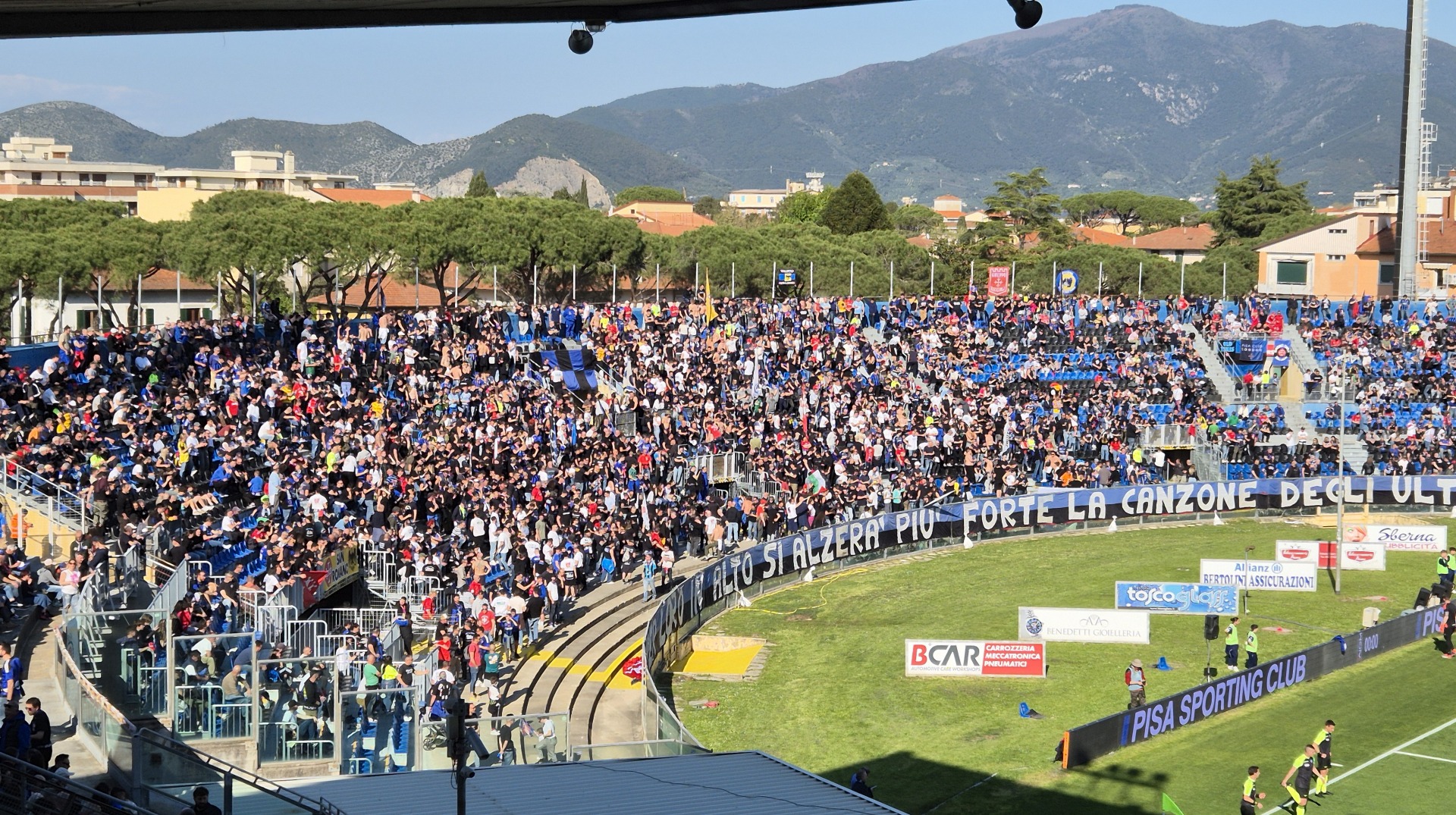
With five teams across the top two tiers of Italian football, Tuscany is a groundhopper's dream and perfect for a double-header.
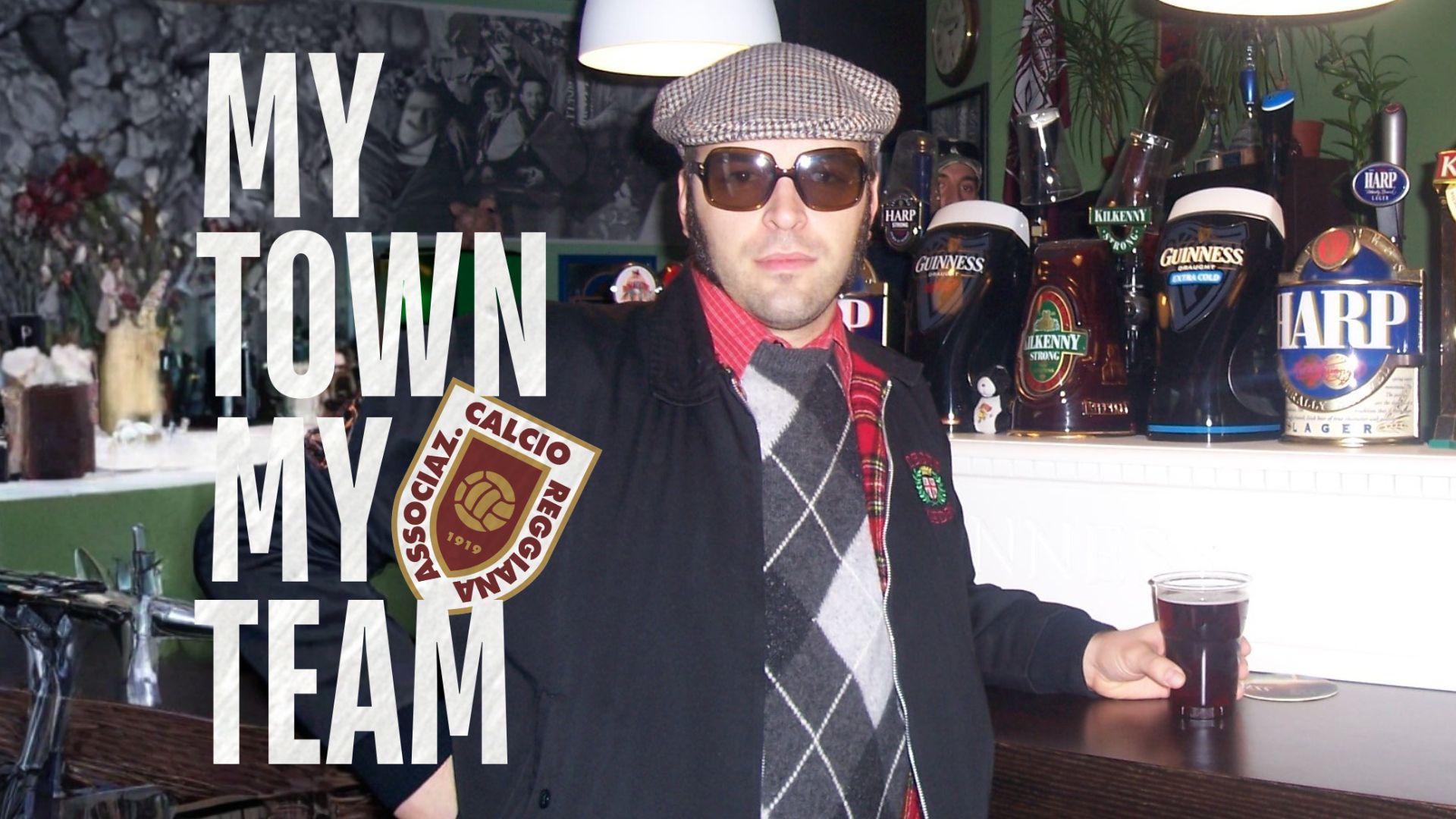
Max Melloni is a 53-year-old architect who sings in a punk band and follows Reggiana home and away.