Mention the city of Moscow to Parma fans of a certain age, and huge smiles will break out across their faces, for the Russian capital represented the apex of the club’s glory years in the 1990s.
The date was May 12, 1999, and Parma were facing a strong Marseille side in the UEFA Cup final at the Luzhniki Stadium. The French side had, after all, knocked out very good teams in Werder Bremen, Monaco, Celta Vigo and Bologna en route, and contained top players in the shape of Robert Pires and Laurent Blanc.
Yet, as good as they were, they were no match for the Gialloblu. The Parma side of 1999 were, on any given day, as good as there was on the continent, with a defence marshalled by the imperious trio of Gianluigi Buffon, Lilian Thuram and Fabio Cannavaro; the magnificent Juan Sebastian Veron pulling strings in midfield and supplying the deadly duo of Enrico Chiesa and Hernan Crespo up top.
Refereed by Scotland’s Hugh Dallas, this was one of the most one-sided European finals of the decade. Marseille could do little to contain Veron, Crespo and Chiesa as they brushed the French side away. Chiesa’s goal, the third of the night, was the pick of the bunch. The Italian smashed a bouncing ball high into the roof of the net after an intelligent dummy from Crespo, following a lofted pass inside from Veron that left Marseille’s defence utterly bamboozled.
As club captain Nestor Sensini lifted the trophy, life could hardly have been better for the side from Emilia-Romagna. It was their second UEFA Cup in four years and their fourth European trophy of the decade, cementing their legacy as one of the teams of the 1990s.
Throughout their golden period, Parma went close to winning the league twice, but they undoubtedly saved their best performances for nights under the lights in cup competitions.
“We neither had the mental stamina nor the resilience to win the Scudetto,” then-coach Nevio Scala said in an interview with the AIC – Association of Footballers in Italy. “But in a one-off game, I can honestly say we were almost unbeatable.”
Their squad, small but filled with quality, lent itself more to the sprint of a cup format rather than the marathon of a Scudetto tilt.
Promoted to Serie A for the first time ever in the months before Italia 90, they won the 1992 Coppa Italia by beating Juventus over two legs. This earned entry into the 1993 Cup Winners’ Cup and they made it all the way to the Wembley final and a date with Royal Antwerp. Goals from Lorenzo Minotti, Alessandro Melli and Stefano Cuoghi sealed their first European trophy, six years before their crowning moment in Russia – to the very day.
They came close to retaining their crown the following year, losing 1-0 to Arsenal, before winning the 1995 UEFA Cup in a titanic, two-legged tussle with Juve that saw Dino Baggio come back to haunt his former side with two goals. A week before the 1999 victory in Russia, Parma had seen off Gabriel Batistuta’s Fiorentina in the final of the Coppa Italia.
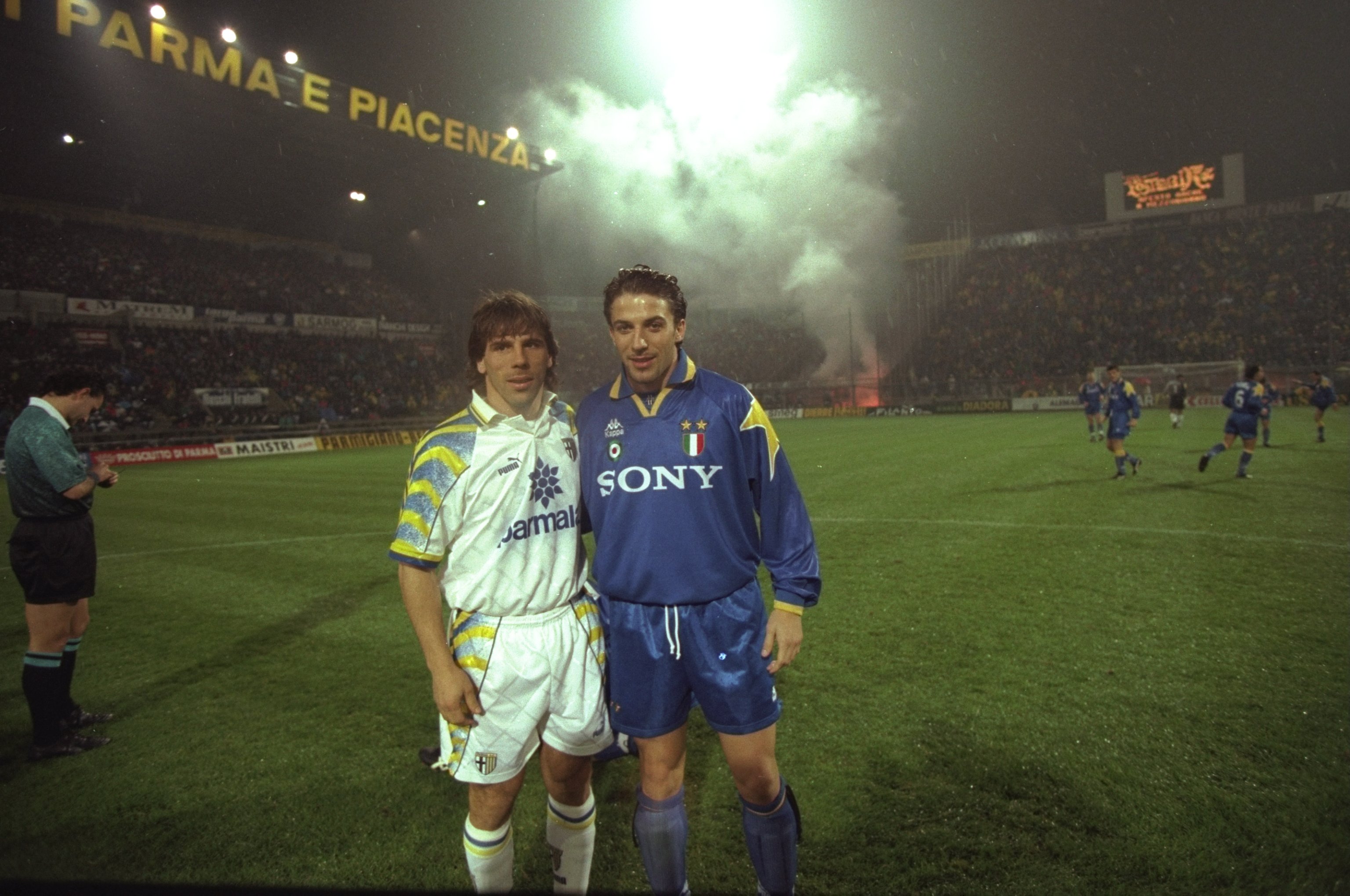
With its compact, boxy feel, the Stadio Ennio Tardini proved to be an intimidating place for visitors during the 1990s. Indeed, from 1991 to 2001, they only lost four European games under the lights there, a spectacular record considering they were in European competition every season throughout the period.
An intimate ground that holds around 22,000, the lack of running track means it can feel as if fans are almost on top of the players, helping to create a hostile atmosphere for visiting teams. While the Gialloblu’s days of challenging for European honours are long gone, Parma remains a bucket-list destination for football purists of a particular vintage, much of it owing to their 1990s success and a feeling of nostalgia for the era of the ‘seven sisters’ in Serie A.

As the heat disappears from central Italy and the cold, fog and rain descends while autumn gives way to winter, the mood around this part of the country can shift. Hot drinks replace cold ones and winter clothes are brought out of storage. This can mean only one thing: nights under the lights will be returning to the Tardini very soon, and Parma have some cracking games worth considering. Between now and the middle of January there are seven home fixtures to choose from, with most of them in the evening.
Our picks would be the Emilian derby with Bologna in early November, the home game against Napoli in early January or the match with Inter just a fortnight later. Parma have averaged just under 19,000 spectators over the last two seasons since returning to Serie A, yet for games against the big sides the ground is always at capacity.
“Night games remind me of those cup games during the 1990s. Back then only European or Coppa Italia games were played at night, and so they bring me back to those legendary days and victories in cup competitions,” said Mattia Tassi, a senior member of Parma’s ultras. “It’s not just a psychological condition, people are more fired up for night games.”
Located in the south of the city, the Tardini is a tranquil, 20-minute walk from Parma Cathedral in the centre. On your way to the ground be sure to stop by restaurant Trattoria Sorelle Picchi, a favourite of current Parma owner Kyle Krause, for anolini in brodo. This is a local pasta, stuffed with meat and served in a broth that will warm your soul and get you ready for the game. If you need a warm drink, try vin brule, a form of mulled wine common in markets throughout the city.
The Tardini is one of those stadiums that’s best seen at night. When the lights are turned on and the crowd files in, it makes for a dynamic atmosphere. While Milan, Naples, Rome, Genoa and Turin often steal the spotlight, a night match in Parma should be near the top of any football fan’s wish-list. Memories of Crespo, Veron, Buffon, Gianfranco Zola and Faustino Asprilla strutting their stuff here will come flooding back.
Related Topics
Related Articles
Related Articles
As the temperature dips, stadiums around Italy come alive with smoke, fog and fireworks cutting through the frosty air.
The home kits looked to tradition and the away kits went retro. The third kits are where Serie A clubs take more risks.
Ever fancied two Serie A games in two days while visiting one of the world's food capitals? It's doable in Emilia-Romagna.