It was May 2021 and the news suddenly broke: Jose Mourinho was returning to Serie A to manage Roma. In the current era where transfer news – for players and coaches – can drag on for weeks and months, Mourinho’s move to the capital as a replacement for Paulo Fonseca was a bolt out of the blue.
It was seen as a major coup for the club and sure enough, Mourinho touched down at Ciampino Airport in a private jet in early July and was met by thousands of Roman fanatics, all hoping to catch a glimpse of The Special One.
One fan even held up a banner depicting Mourinho as the Pope, ready to save the Giallorossi after years of suffering. While Mourinho’s stock in England had dropped due to underperformance with Manchester United and then Tottenham, there was no such thing in Italy, where memories of the Treble with Inter Milan in 2010 loomed large.
Now, a couple of months into his second spell as Real Madrid manager, he kicks off their Champions League campaign against the Nerazzurri, and he remains the last coach to deliver the Champions League to an Italian club.
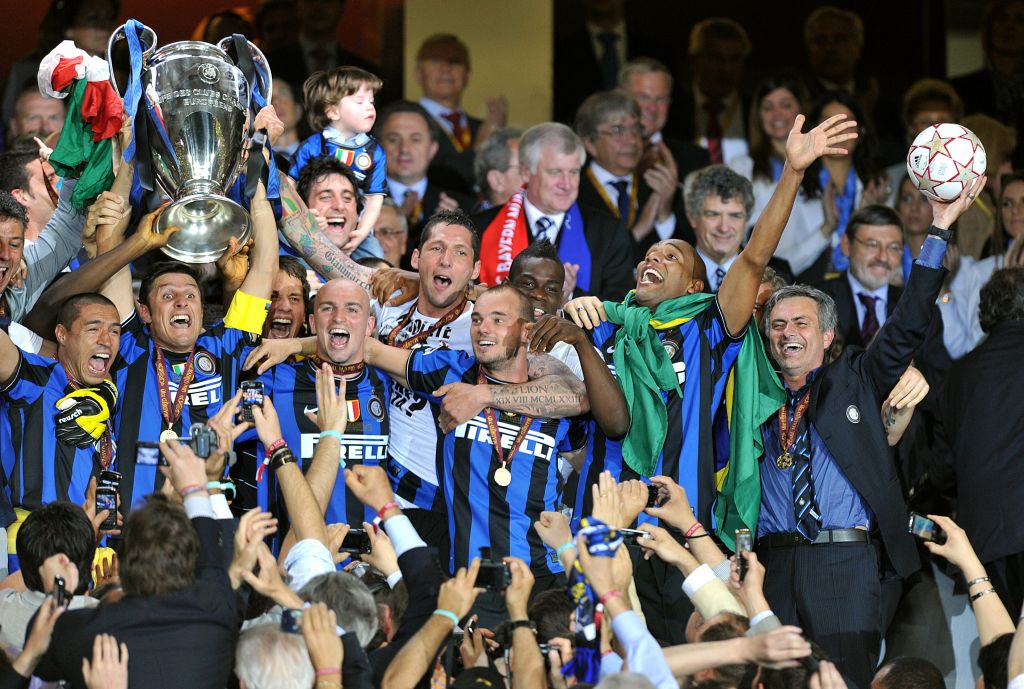
His stint with Inter can, when discussing the context of his career, be considered the final years of a mighty peak. He won the Scudetto in his first season, but knew he wasn’t hired to win the league. This was something Roberto Mancini had managed three years on the bounce and was now almost a given in the face of any genuine challenger.
In the summer of 2009, Inter, at the behest of Mourinho, sanctioned moves for Wesley Sneijder, Lucio, Thiago Motta, Diego Milito and perhaps, best of all, received Samuel Eto’o in the deal that sent Zlatan Ibrahimovic to Barcelona. Mourinho had told Ibrahimovic that if he wanted to win the Champions League he should remain at San Siro.
Yet the combative Mourinho often railed against Italian football and its system, famously saying ‘I love Inter, but not Italian football’, as his days with the club were coming to an end following the 2010 Champions League win over Bayern Munich in Madrid.
He couldn’t have left on more of a high note, walking off into the sunset with the Treble. Fast-forward over a decade and Mourinho was now back, to the one country where his reputation was still sky high.
“I’m much better. I think this is a job where experience means a lot. With experience it feels like everything becomes déjà vu because you have been through so many experiences,” Mourinho said at the time. “Since I left Italy I went to Real Madrid, which was an incredible experience, and I reached my dream of winning (titles in) Italy, England and Spain.”
While Mourinho was his usual brand of arrogance and charm, using Roman dialect and citing Marcus Aurelius, there was a humility that was rarely seen in his previous stint in Italy. “The way people have reacted, I think I don’t deserve that,” he said when asked about the reception he’d received. “Because I have done nothing for them. Of course (I’m) emotional, of course pleased, of course grateful.
“Of course it puts more responsibility on me to not let people with that passion down. I can only say that what they did for me – before I have done something for them because I’ve done nothing for them – I can only be extra motivated. I’m going to do everything to repay all the love and passion they showed me.”
Such was the excitement over Mourinho’s signing in the Eternal City that a mural appeared in the Testaccio area, complete with the Portuguese coach on a Vespa, wearing a Roma scarf, before he’d even managed a game.
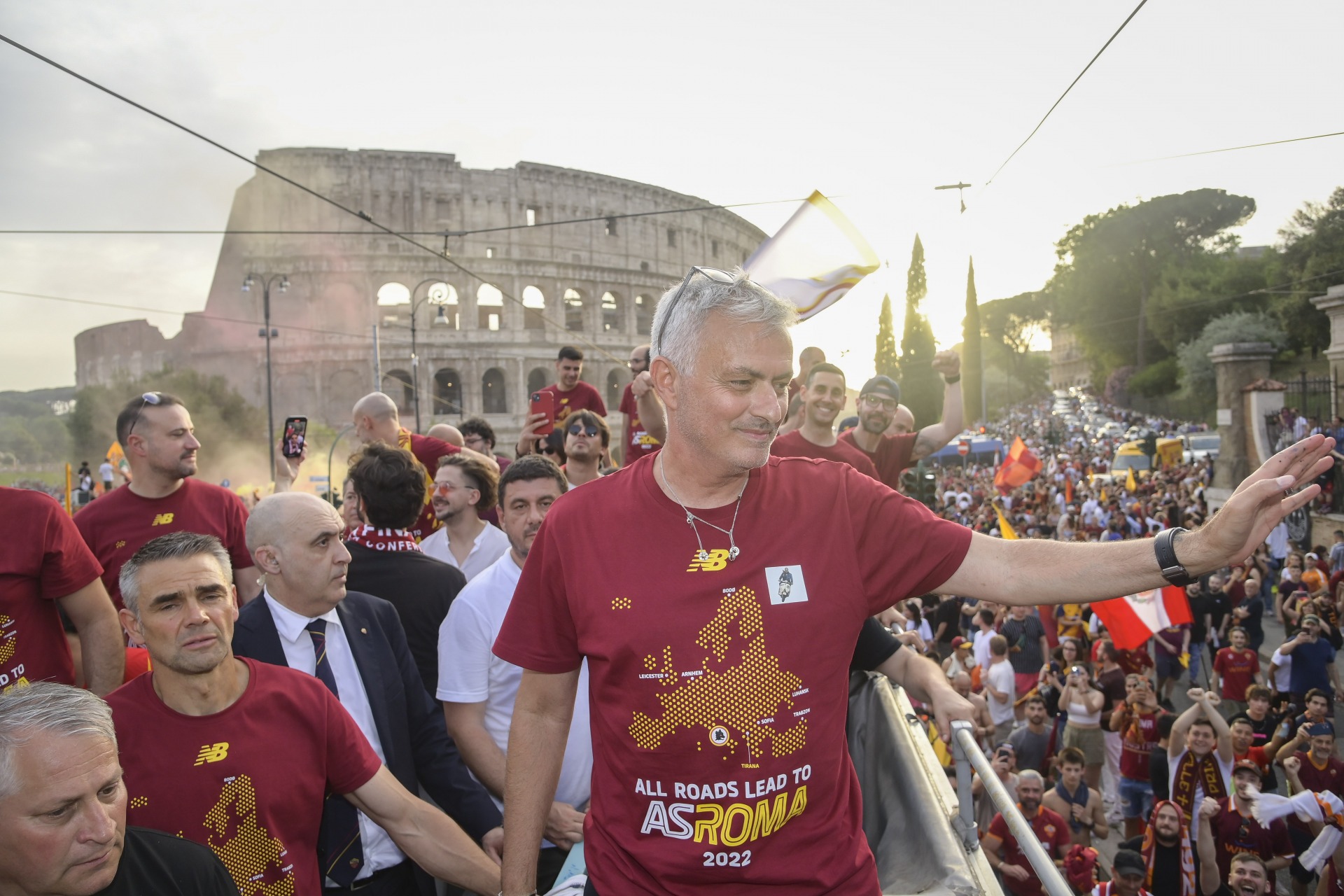
Mourinho didn’t let Romanisti down. In his first season he brought the club their first piece of European silverware for 61 years, in the shape of the Europa Conference League after beating Feyenoord in a cagey final in Albania.
The trophy parade through the capital was enormous. The city was awash with hundreds of thousands of Giallorossi fans, with Mourinho himself driving the team bus for a small stretch of road. To solidify his bond with the club, he had the trophy tattooed on his arm.
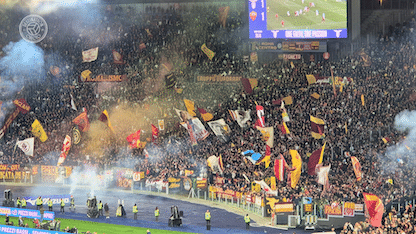
The Mourinho effect was in full force, as fans returned to the Stadio Olimpico in their droves. Prior to his arrival, the average attendance for the last complete season (2018-19) was 38,000. That jumped to over 41,000 in his first campaign, 62,000 in his second and the same figure for his last. The club has never dipped below 60,000 since, with those kinds of numbers not seen since the dawn of the new millennium. It really is a stadium worth visiting.
Despite the passing of time, Mourinho’s volatility on the sidelines didn’t diminish, however. He was sent off six times in the latter phase of his Roma stint for repeated theatrics and berating officials.
Yet Roma reached another European final in 2023, narrowly losing the Europa League to Sevilla in Budapest. This was, in hindsight, the beginning of the end for Mourinho. His public outbursts at English referee Anthony Taylor crossed a line for many within the club, and as results declined in his third season amid more arguments with officials, Mourinho appeared a man raging against the dying of the light.
He was sacked weeks into 2024 after a defeat by Lazio in the Coppa Italia. While he’d lost the support of the club, the players and fans hadn’t abandoned him, with many going to the training ground to see him off one last time. “We told ourselves that if he asked us to hit our heads against a tree, we would all do it,” said midfielder Lorenzo Pellegrini about Mourinho in 2025.
Mourinho has gone on record saying his Roma spell was his highlight, despite the bitter end. “For me, Rome was the best place of my career. I’ve never felt such an incredible environment around a football team,” he said recently.
“A football team, the Olimpico always full, the way people feel about the players. It’s not a drama because when we won the Conference League, the celebrations were amazing. Not even when I won the Champions League did I see scenes like those.”
Two-and-a-half years on from his departure, Mourinho’s popularity among Romanisti remains as strong as ever. When he returns to the Eternal City as coach of Real Madrid in October, he’ll be welcomed as a conquering hero. The Emperor who brought honour, and the crowds, back to the modern day Colosseum.
A Roma match in all its glory at the Olimpico means a packed house of over 60,000, all singing Antonello Venditti’s official club anthem in deafening unison. All because of Mourinho and the house he rebuilt.
Related Topics
Related Articles
Related Articles
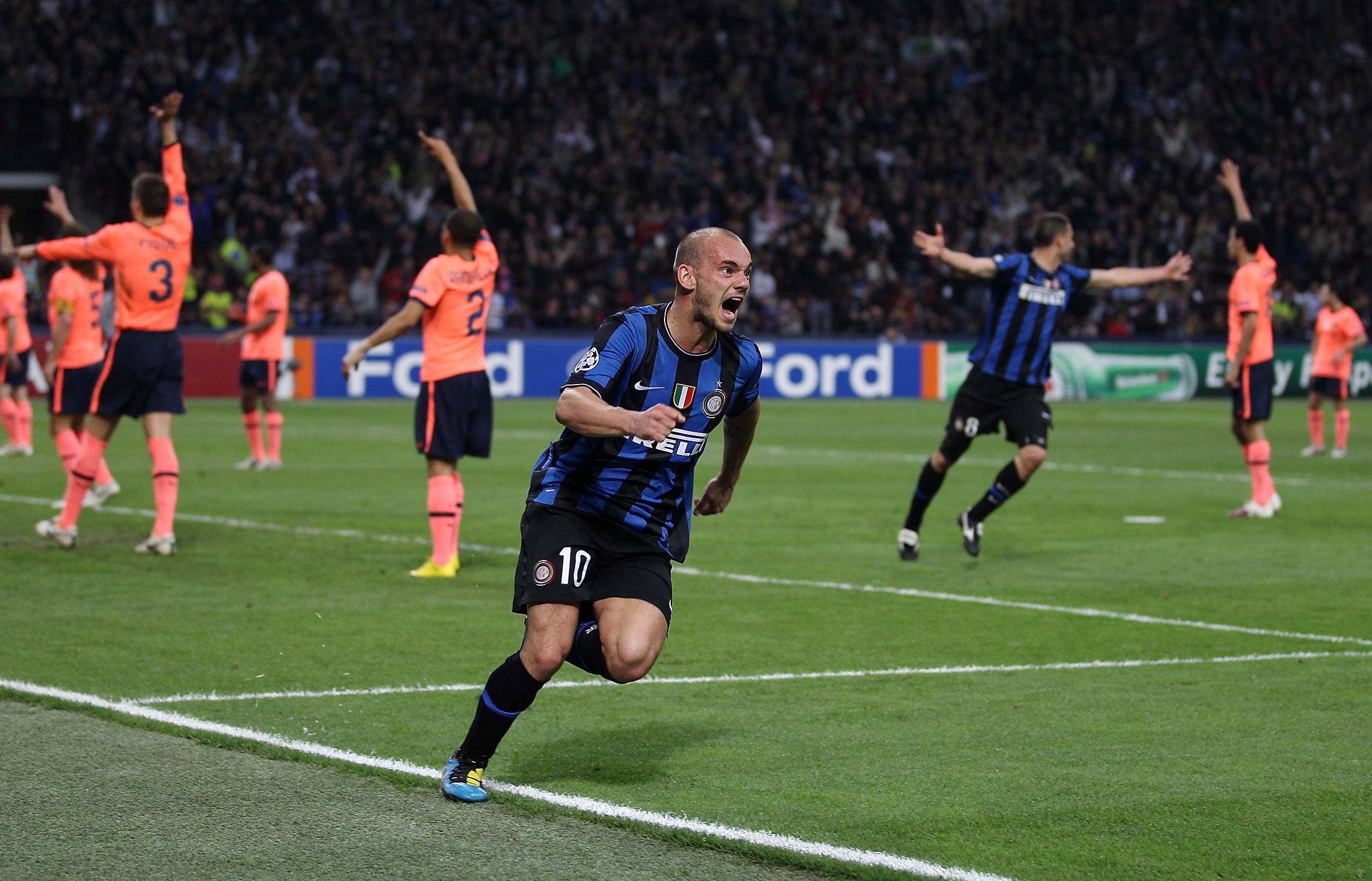
Italian teams have, over the years, been involved in some epic encounters on the continental stage. Here are seven of the best.
Up and down the country, each stadium is unique and every single one has its own charm. This is our top nine.
Watching Italian teams in the Champions League and Europa League can be straightforward and affordable.