

How Diego Maradona Saved a Filmmaker’s Life and Inspired a Love Letter to Naples
By Emmet Gates
Paolo Sorrentino couldn’t contain his happiness at the 86th Academy Awards in the Dolby Theatre in Los Angeles. Sorrentino was on stage, with close collaborator Toni Servillo, having just been handed the Oscar for Best Foreign Language Film.
Sorrentino’s film, La Grande Bellezza (The Great Beauty), traces ageing author and night owl Jep Gambardella’s journey as he questions his life choices while wandering the streets of Rome. After being handed the prize by Ewan McGregor and Viola Davis, Neapolitan Sorrentino began his speech.
“Thank you to the Academy. Thank you to Toni and Nicola (Giuliano) and all the actors, producers and the crew,” said Sorrentino. “Thank you to my sources of inspiration: Federico Fellini, Talking Heads, Martin Scorsese, and Diego Armando Maradona.
“And thank you to Roma and to Napoli and my personal great beauty, Daniela, Anna and Carlo. And thank you to my brother Marco, my sister Daniela, and this is for my parents. Thank you very much. Thank you.”
There can’t have been many footballers mentioned in an Oscar speech. While you’d be quick to assume that the nod to Napoli’s greatest-ever player is due to Sorrentino being a son of Naples and what the Argentine genius gave to the city, it goes much deeper than that.
Sorrentino has revealed many times over the years that Maradona, in fact, saved his life. In 1987, when Sorrentino was 16 years old, he did not go with his parents to their ski house, choosing instead to watch his hero and Napoli take on Empoli.
On that trip, his parents died from carbon monoxide poisoning caused by a gas leak. Sorrentino believes he owes his life to Maradona. When Maradona learned of Sorrentino’s Oscar tribute, he sent a personalised shirt.
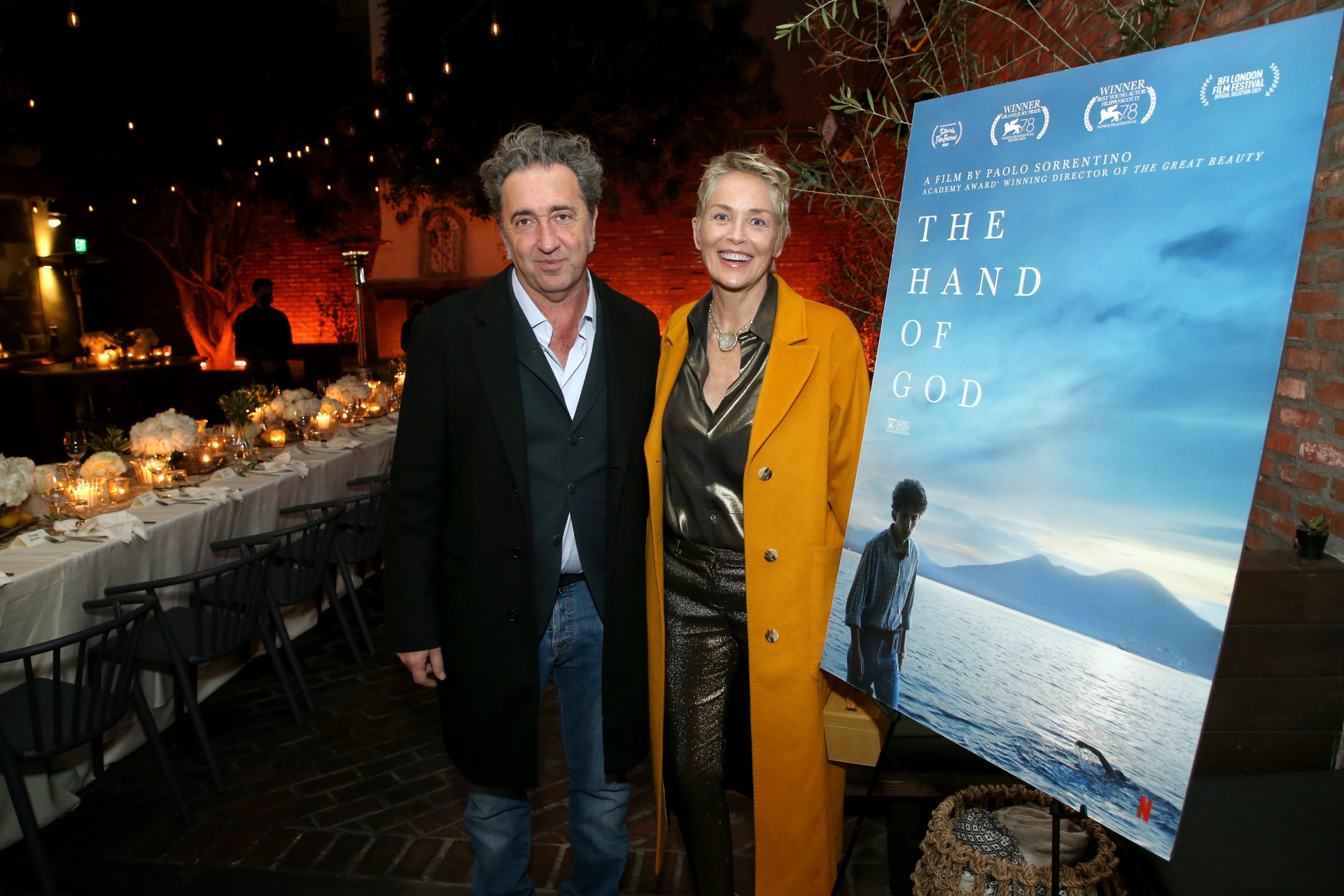
The tragic story of his parents forms the bedrock of Sorrentino’s highly personal 2021 film E stata la mano di Dio (The Hand of God).
The film follows the story of Fabietto Schisa, essentially a young Sorrentino, as he navigates his teenage years through the turbulent world of 1980s Naples, the arrival of Maradona, the death of his parents and his ambition to become a filmmaker in Rome. It’s a semi-autobiographical movie filled with colour, trauma, happiness and inspiration.
“Maradona inspired me to become a film-maker. He was my first contact with spectacle – with entertainment – because he was indeed a sportsman, a soccer player, but also an entertainer,” said Sorrentino in an interview with The Irish Times while promoting Hand of God.
”It was my first contact with a high form of entertainment, which was also very rich.”
Sorrentino only got to meet Maradona once, a fleeting and, according to the filmmaker himself, ‘awkward’ encounter during a Champions League match between Real Madrid and Napoli in the Spanish capital. He had hoped to screen the finished product for him, but Maradona died in 2020.
From Sorrentino’s opening shot of the Gulf of Naples, and the crystal-clear water of the Tyrrhenian Sea coming into view, the film is rich with the colour and vibrancy that Naples is known for.
It’s not long before Piazza del Plebiscito makes an appearance. The square is one of the most iconic locations in Naples, with its odd shape – a semi-circle meets a rectangle. The piazza is where Napoli fans celebrate title wins, as was the case when Destination Calcio visited in May 2025. Goals from Scott McTominay and Romelu Lukaku secured an unlikely Scudetto on the final day and the city erupted into frenzied euphoria, the night sky ablaze with flares and fireworks for hours.

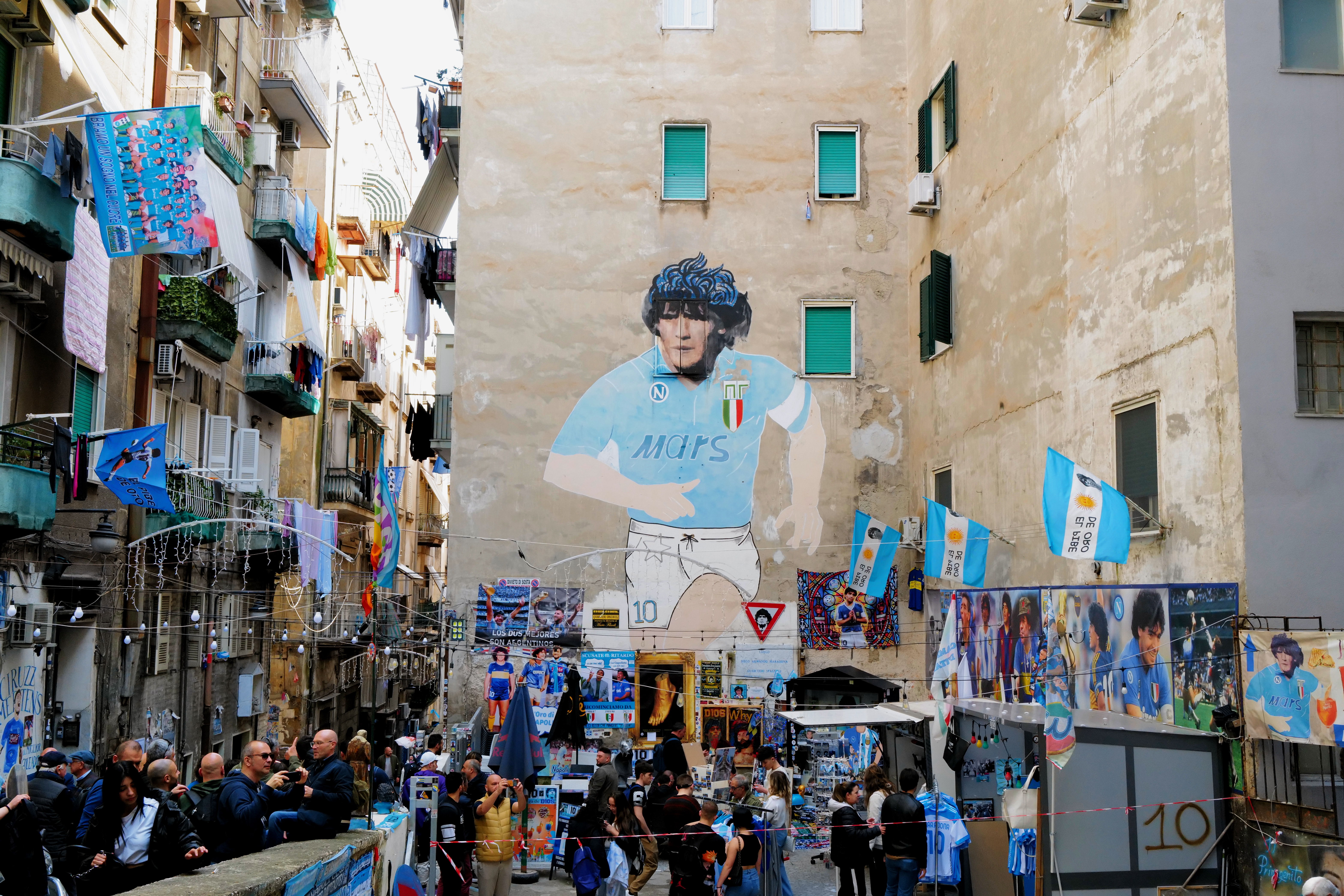
While only making a fleeting cameo in the film, the famous Spanish Quarter is shown, with its claustrophobic and mural-heavy alleyways instantly recognisable. Quartieri Spagnoli is, in many ways, the beating heart of Naples, and the area is a must for any calcio diehard, with paintings of Maradona and other Napoli alumni such as Dries Mertens, Careca, Frank-Zambo Anguissa and Victor Osimhen, among others.
The Stadio Diego Armando Maradona, then called the Stadio San Paolo, is also depicted in the film. The Fuorigrotta zone, where the stadium stands, was the playground of a young Fabio Cannavaro during the same time period the Hand of God is set in, with the wide-open spaces around the Maradona ideal for playing street football and honing his craft.
Now, Fuorigrotta is a mix of shops and residential apartments. When we’ve been in town to watch Napoli play, Caffetteria Degli Azzurri, across from the stadium, has been our go-to spot, with its combination of coffee shop and restaurant making it ideal for any occasion.
As shown at the end of the film, Sorrentino moved away from Naples to start a new life in Rome and chase a career in film. Upon returning to the city to make the film, he found that things had changed. “It had been years since I’d spent that much time there,” he revealed in an interview with Variety. “I realised that Naples, for better or worse, is bursting with a vital energy that I rediscovered.
“The vitality of this city is something that was buried in my youth, which I had completely forgotten.”
At one point during the film, roars can be heard coming from houses all around Vomero, the middle-class area where Schisa and his family lived. The noise was coming from the 1986 World Cup, and the game was Argentina against England.
The links between Argentina and Naples go back long before Maradona’s arrival in 1984, yet what he achieved in those seven chaotic and heady years only reinforced the bond between the two. During the summer of 1986, Naples was either supporting the dark blue of the Azzurri, or the light blue of the the Albiceleste.
When Maradona took his Mexico 86 form and transferred it to his club performances, securing a first league title 11 months later, he cemented his place in the history of his club and the city.
No matter the district you visit in Naples, and no matter your method of transport into the city – by car, train or plane – his face will greet you from the second you arrive. Maradona murals are everywhere, and almost any ornament can bear his face or name. Naples is an open-air shrine.

Throughout the movie, amid the trials and tribulations of the fictional Schisa, the spectre of Maradona looms large, not just over the character, but over the city. For Sorrentino, Maradona represents something grander.
“Maradona — besides being what he’s been for many of my generation in that city, a sort of strange divinity –– is someone who became what he became, despite everything and everyone,” Sorrentino told Variety.
The Hand of God is not just a tribute to Maradona and how a kid from a shanty town on the fringes of Buenos Aires can redeem a city halfway across the world and inspire millions of its citizens, including Sorrentino, to become something greater. It is also a love letter to Naples, a city that simply has to be experienced.
Related Topics
Related Articles
Related Articles
Up and down the country, each stadium is unique and every single one has its own charm. This is our top nine.
As the temperature dips, stadiums around Italy come alive with smoke, fog and fireworks cutting through the frosty air.
Some of the biggest grounds in the country must be replaced or renovated before the European Championship kicks off.